
The Online Writing Instrument Magazine -
Vaporite Brush Pen c1946-1956
by Jim Mamoulides March 3, 2003, updated July 4, 2005 and August 23, 2015
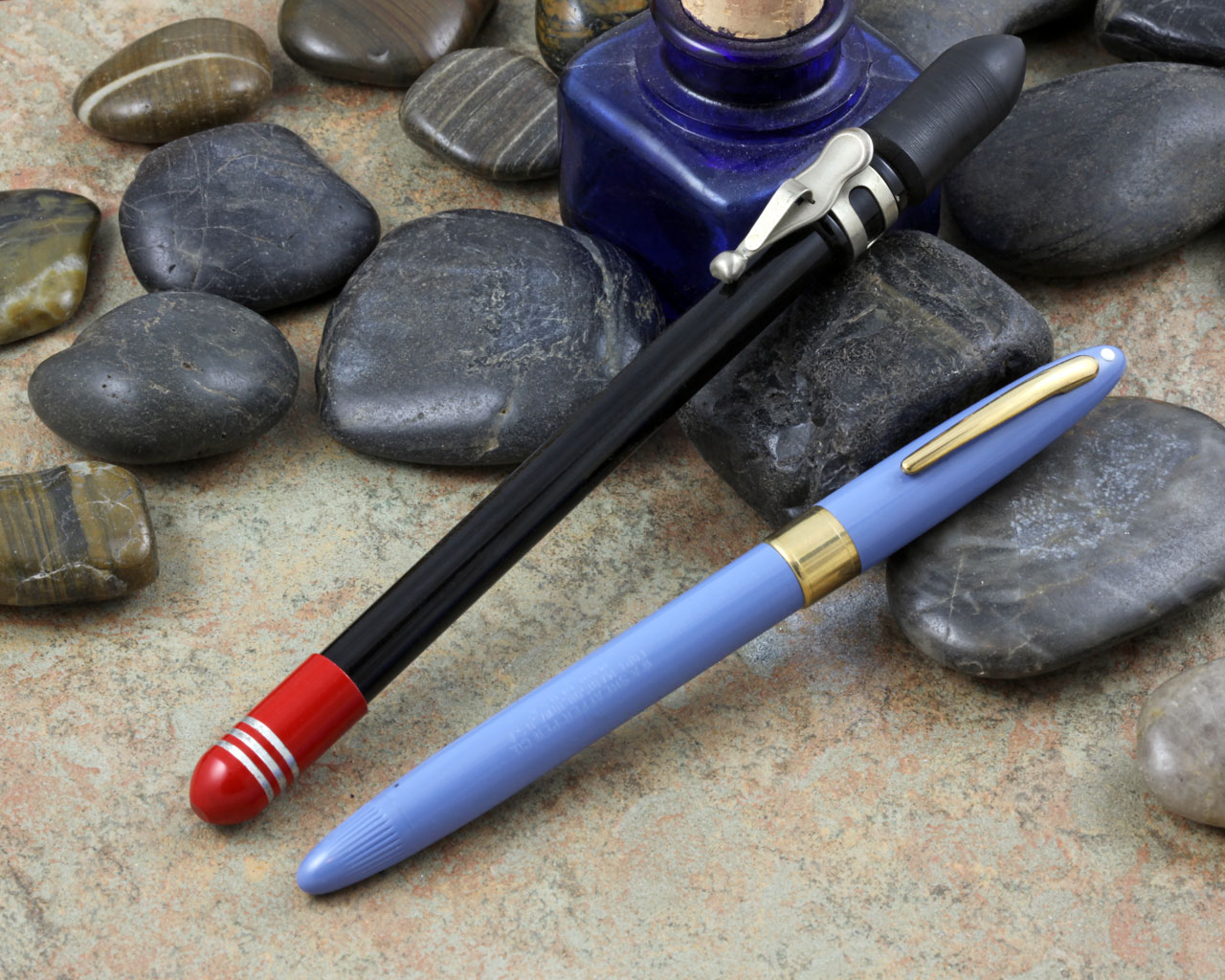 The Vaporite Brush Pen came in basic black with a cool red tip! Shown next to a Sheaffer Snorkel in Periwinkle Blue for size comparison.
The pen for the artist in you
It arrived in a bag of pens I bought. A six and three quarter inch metal stick with a big squeeze bulb on one end and a bright red, silver ringed cap on the other. A huge clothespin clip near the bulb, which I guess meant that was the "top" and the red end cap covered the "business end" of the pen. What exactly is this thing?
The barrel is metal, as is the cap, and is stamped, "VAPORITE BRUSH PEN - MLPS MINN. REG. PAT.", clearly indicating that something very odd was going on in the cold winters of the northern heartland.
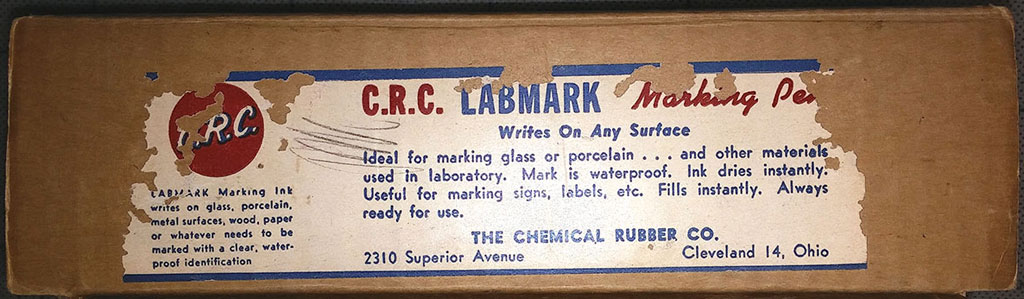 C.R.C. package for the Vaporite Brush Pen, image courtesy Mike Hungerford.
I can honestly say that I did quite a bit of searching and reading trying to find out about this strange beastie, with very limited results. The small snippets of box and photos of a very few examples, including jars of ink intended for use with the Vaporite Brush Pen indicate that it was trademarked and likely manufactured by the Lanak-Roehl Manufacturing Company, Minneapolis, Minnesota, but marketed both by Time Saving Specialties of Minneapolis, Minnesota and The Chemical Rubber Company of Cleveland, Ohio, the latter using the product name "C.R.C Labmark Marking Pen." In all cases, the pen itself is identical and bears the Vaporite stamping on the barrel.
The pen appears to be an early attempt at making a refillable felt tip pen, a more crude design than the much superior Esterbrook Flo-Master refillable felt tip marker, which Esterbrook acquired in 1953 as part of their purchase of Cushman & Denison. The Flo-Master, introduced it in 1951, also had easily exchanged replacement tips in multiple sizes. In spite of the patent claim on the barrel, I have been unable to confirm that the pen or any aspect of it is indeed patented.
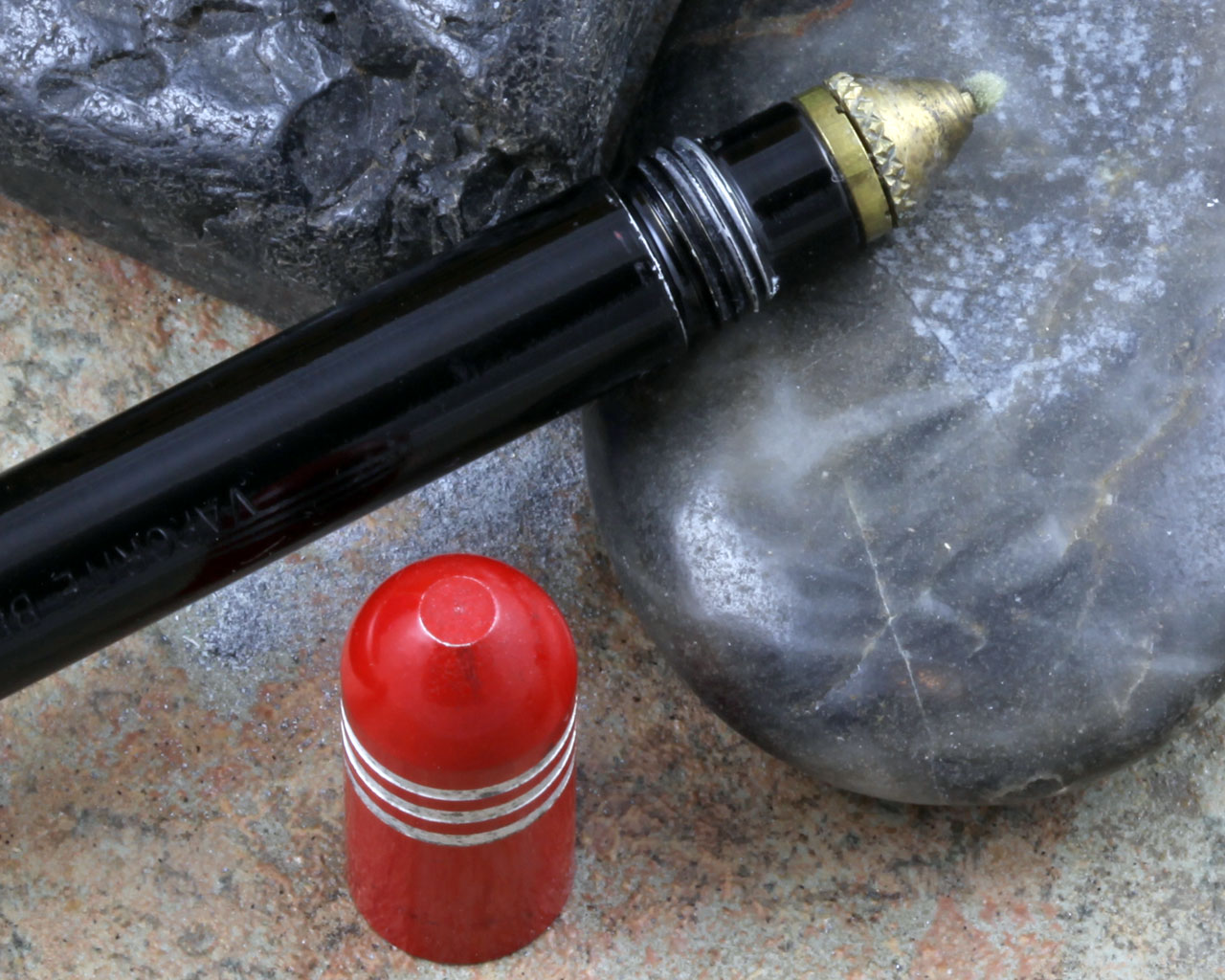 Detail of Vaporite Brush Pen "nib" (It's the thing sticking out of the tip)
A pen for John Henry, not John Hancock
Unscrewing the cap reveals a brass cone with fiber protruding from the center. This is obviously the "brush" part. The cone screws in and out giving some mild variation to the thickness of the fiber brush, evidently allowing for some adjustment of the width of the line the pen can write, as well as a way to secure it in the pen. In practice, there's not wide range of adjustment, basically really broad to really, really broad.
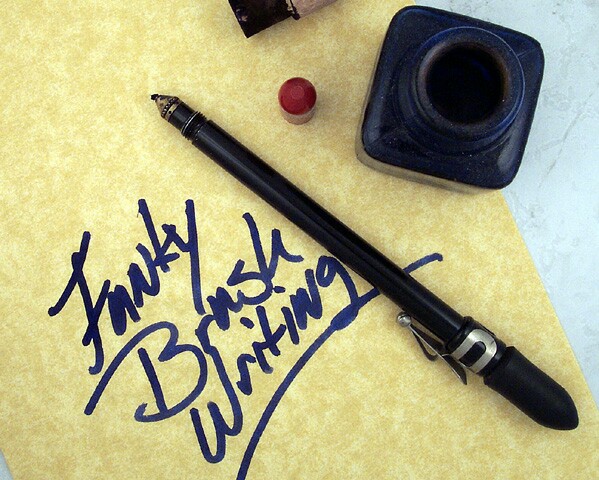 You can write REALLY BIG WORDS with your Vaporite Brush Pen!
The Vaporite Brush Pen is a "classic" bulb filler, though certainly not in a way one would usually expect, where the bulb is usually not external or part of the "design statement." The bulb is quite rigid, obviously made so as to not be easily depressed and accidentally spill ink. This is a very heavy-duty pen, made for writing really big, bold statements.
 Vaporite Brush Pen instructions image courtesy Andy Evans. Labmark Self-Filling Marking Pen instructions image courtesy Mike Hungerford.
The Vaporite Brush Pen is quite easy to fill and use. One subtle difference in use between it and other fountain pens is that the instructions explicitly tell the user to fully expel all excess ink from the pen after filling. The brush, acting like a wick, will hold a large amount of ink, but it may bleed if excessively wet. I didn't notice this in my use of the pen, but considering the wick action of the brush, it makes sense.
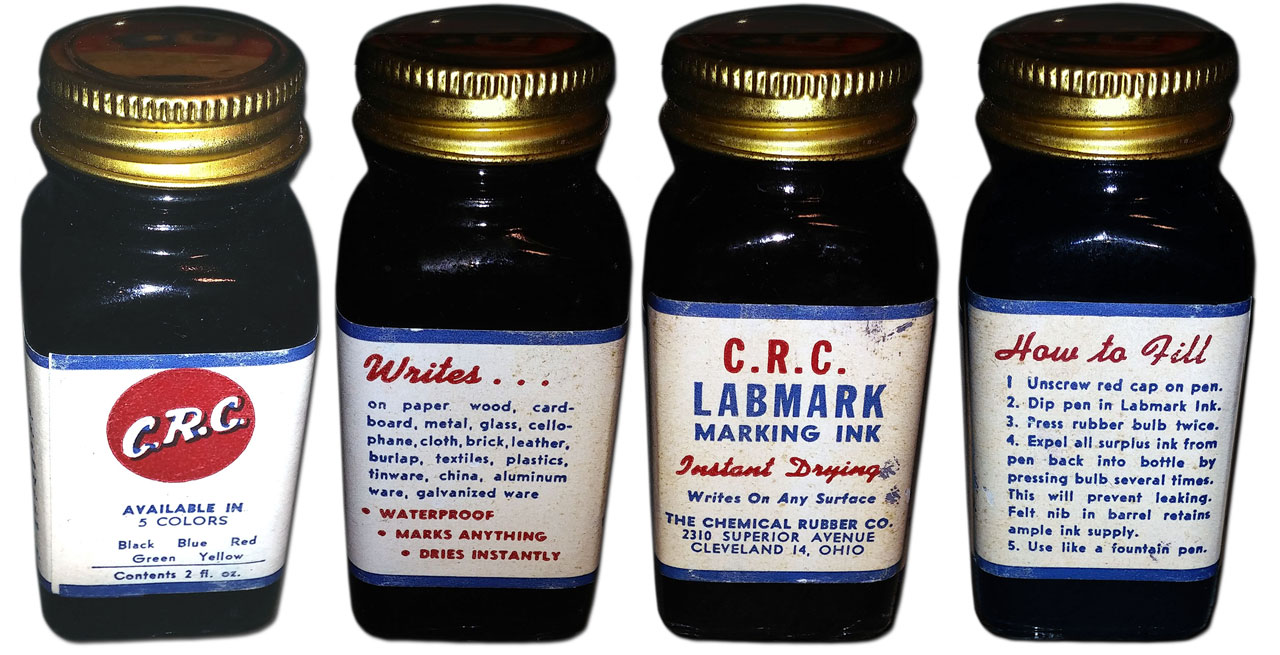 C.R.C. ink bottle, specifically for the Vaporite Brush Pen, image courtesy Mike Hungerford.
Because the Vaporite Brush Pen was marketed as a permanent marker that could write on multiple surfaces, specialty ink was also sold for the pen. This ink claimed to write on pretty much anything and was waterproof. Just see what you can write on from the list on the bottle: cardboard, metal, glass, brick, china, and much, much more! This ink would have to be hard to get out. Not to fear, as long as you have some #100 Vaporite Flushing Solvent, you can get that permanent ink out of the pen and move on to other colors and flavors. Ink colors were black, blue, red, green and yellow. I'm guessing that yellow was not high lighter yellow.
Felt magic inside
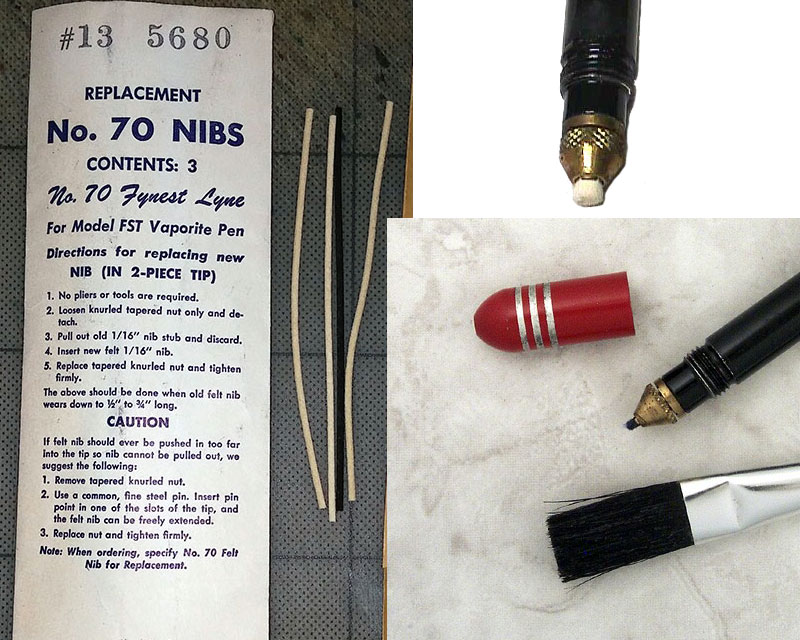 Vaporite Brush Pen replacement nib packaging showing the nibs and details of the nibs in the pen. Packaging image courtesy Mike Hungerford.
Ron Tucker contacted me because he found one of these funky pens and wanted to know, "Have you established any kind of value for this pen?" He was interested in the pen and also in its design and functionality, but the pen he had found was missing the bulb. During our email conversation, he related some interesting information about the inner workings of the pen, and how it stores and feeds ink.
Ron put "a drinking straw into the upper hole, ( a tight fit ) [and] a felt piece of absorbent material came out. This is the ink holder. It is split lengthwise and 3-4" long. . . . The gray piece of felt is 3/8" x 4' in length, and about 1/16" thick, curled like a burrito to fit snugly inside the barrel." Ron's discovery demonstrates that the barrel is not just a big hollow vessel as in an early eyedropper, but that the Vaporite designer wanted to have flow control of the ink and had decided that a long barrel-length wick would serve as the perfect feed to the felt tip, and also keep it wet when not in use.
Great detective work, Ron!
There is nothing like this pen in stores today. The idea of a refillable marking pen has gone the way of many other things in our disposable pen culture. These are uncommon pens, and when they do show up for sale, they are often ink clogged and the felt nibs are rare to find. Sometimes, as with the pen I have, they are completely unused. I believe they were eventually replaced with throwaway permanent markers and tossed.
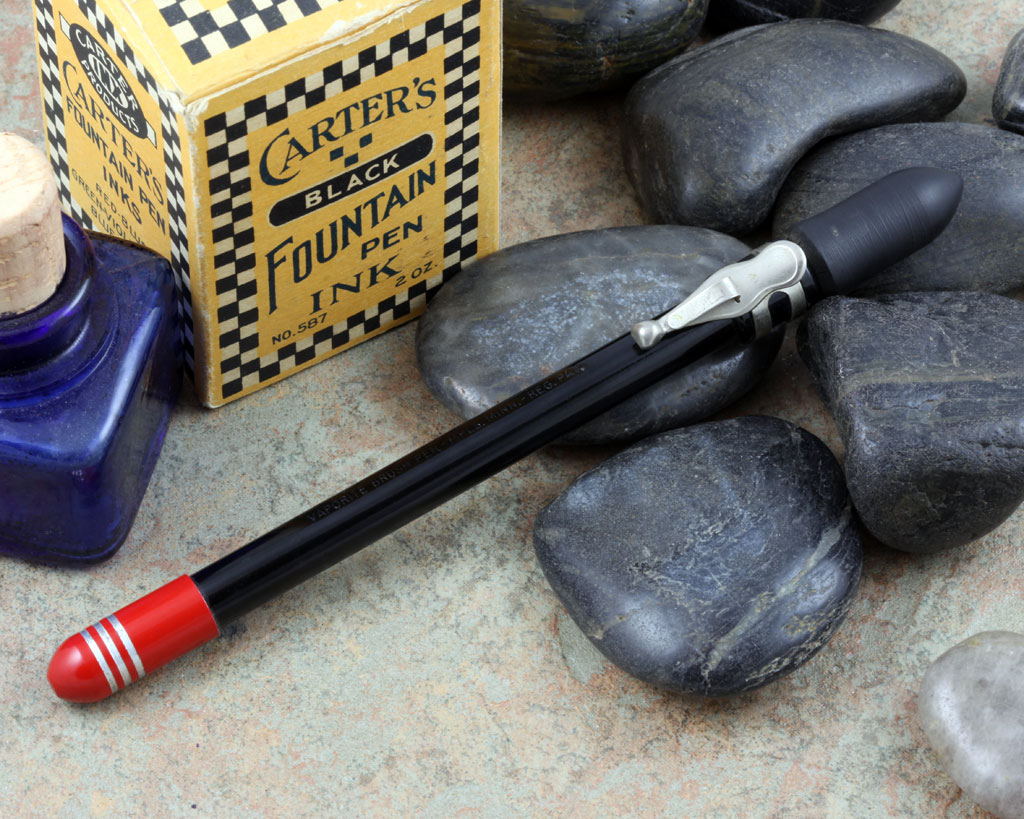 Vaporite Brush Pen
Identification guide and features:
There is very limited original documentation on this pen. I was able to find a trademark registration that shows the Vaporite name was first used in September, 1946 and an advertisement seeking sales agents for the Vaporite brush pen in March, 1956. That and actual packaging examples showing the pen marketed both as the Vaporite brush pen and as the Labmark Self-Filling Marking Pen, but in all cases, the pen itself is marked "VAPORITE BRUSH PEN - MLPS MINN. REG. PAT." At minimum, the pen was marketed from 1946 through 1956.
- Black painted metal barrel
- Red painted screw on nib cover with three silver painted bands
- Metal clothes pen type pocket clip
- Black rubber bulb as filling method
- Uses replaceable felt threads as "nib"
- Barrel stamped with "VAPORITE BRUSH PEN - MLPS MINN. REG. PAT."
- Fine felt nib replacements observed
Performance
Durable is the word that came to mind when I was trying to think of a way to describe the construction of the Vaporite Brush Pen. It's heavy-duty, without being overly heavy. It looks more like a tire gauge than a pen. Certainly something a mechanic could carry and not be able to beat up badly, though what is that mechanic going to write on? Tires? It simply does not compare to anything else. I once owned an all-chrome plated Esterbrook Flo-Master felt tip that seemed to have the same design intent, but that was much more "pen-like" than this tool.
 Vaporite Brush Pen ready to write! Note stamping on barrel.
The Vaporite Brush Pen is very long at 6 3/4 inches capped. You won't be posting this pen, considering the bulb constitutes the end of the barrel. Just put the cap in your pocket while you make like Zorro. If you decide to holster this thing, it actually sits fairly low in a deep pocket because the metal clothespin clip is very high on the end of the barrel. It also has a very secure grip. Once seated, you could go to a limbo marathon, lose all your change and other pens, but this one's not going anywhere until you tell it to.
The pen fills very easily. Remove the cap, dip the brush in ink, and squeeze the bulb several times and wipe. There's no way to know how full the barrel gets, but flushing jets out a lot of liquid.
 The Vaporite Brush Pen fits neatly in any artist's pocket!
There is nothing in your pen case that can match the Vaporite Brush Pen in the line width department. Think pre-school crayon size lines and you're thinking too small. Astronauts will be able to read your letters. From space.
Is it a wet writer? Wow. Do you even have to ask?
Will the Vaporite Brush Pen sneak into your rotation and become your everyday user? Maybe if you're Banksy. The pen does what it was made to do - write really big letters and stuff, and that's the full extent of its ability. This is the pen world's blunt instrument. If huge is your passion, this is your pen!
Acknowledgement
Thanks to Ron Tucker for reporting on the inner workings of the Vaporite Brush pen.
Thanks to Andy Evans of Andy's Pens for supplying the instruction sheet.
Thanks to Mike Hungerford for providing additional images and information.
References
Trademark, "Vaporite," both image and Word Mark, Registration Number 0576047, Lanak-Roehl Manufacturing Company, filed July 10, 1952, first used September, 1946
Popular Mechanics, March, 1956, page 66
Interact
Comments on this article may be sent to the author, Jim Mamoulides
Pen Clubs

Social Media


Pen Forums