
The Online Writing Instrument Magazine -

Wearever Pennant c1950-1960
Jim Mamoulides 12/29/02 - Updated 4/4/04
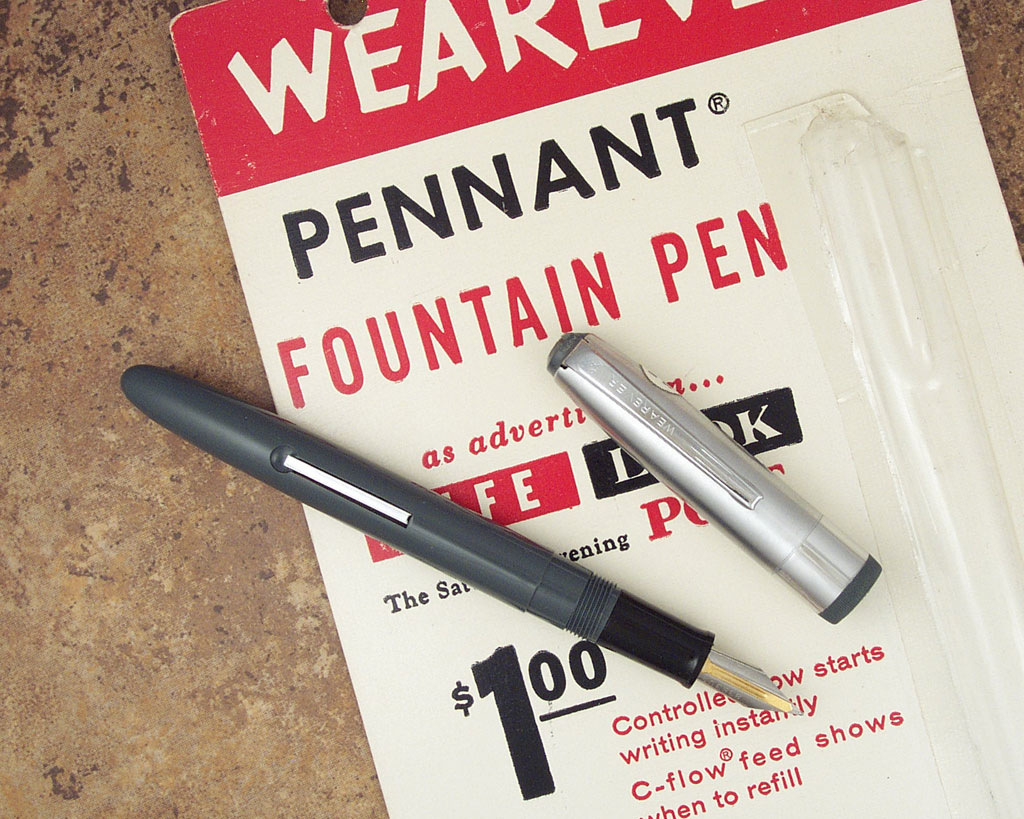 Wearever Pennant fountain pen, version 2, Gray c1956-1960
The Pen That Panicked The Public!
Next to the Supreme, the Pennant is probably the most common Wearever you will find in the field. The Pennant is the consummate "dollar pen", sold from about 1950 through the early 1960s. The Wearever Pennant is cheap and nearly indestructible and David Kahn, Inc. sold them by the bucket full. Pennants would be seen typically on card racks and counter top carousels at drug stores and dime stores along with other Wearever products. In advertising, the Pennant got the lion's share in the 1950s.
 Wearever Pennant fountain pen, version 1, Gun Metal c1950-1956
David Kahn, Inc. relished the low price market, with its Pennant ads shouting "World's Largest Fountain Pen Manufacturer" and "Why Pay More?". This is the "Pen That Panicked the Public!" My favorite! Imagine the public pandemonium and mad rushes to stores to scarf up Pennants that must have happened in the early 1950s. The panic must have subsided eventually, as Wearever advertising settled down on value points as the decade rolled on. Though some later advertisements did show crowds of people buying the pens.
 Wearever Pennant fountain pen, version 1, Maroon fountain pen c1950-1956
Early on, the Pennant was largely presented as the value leader at a dollar a pen. Advertisements asked the reader to compare the Pennant to pens costing US $5.00 to $10.00, which would have been the bottom end of the Sheaffer Snorkel line. A heady comparison. The Pennant was also pushed as a school pen, as with many other Wearever pen lines. Advertisements warned, "Don't buy any school pen!"
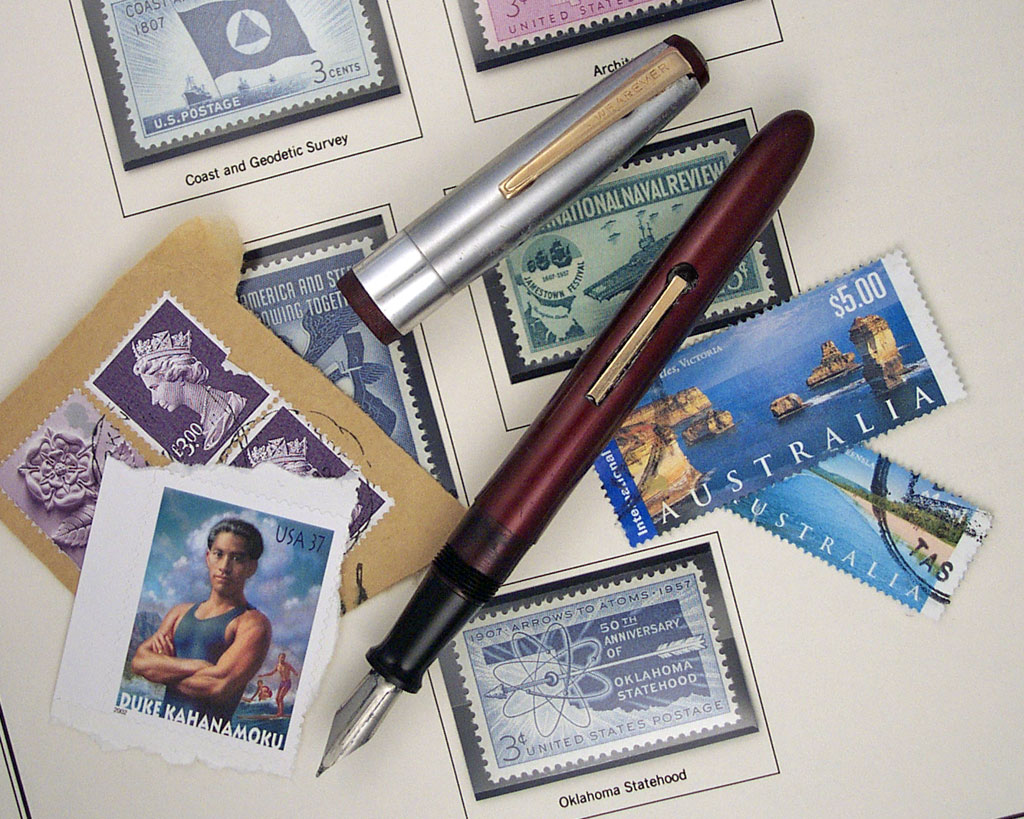 Wearever Pennant fountain pen, version 1, Maroon fountain pen c1950-1956
Pennants came in all the typical 1950s colors: black, burgundy, red, gray, green, blue, and aqua blue. The cap matches the barrel color and has a metal sleeve fitted over it, leaving a coin edge lip and top cap showing that matches the body color. Many collectors believe the metal cap sleeve is actually aluminum, though no documentation has been seen to confirm this. Clips came in gold tone or chrome.
 Wearever PresClik Maroon ballpoint pen as shown in a 1953 ad
David Kahn, Inc. was also an early entry in the 1950s ballpoint race with the PresClik ball pen. The ballpoint refill was extended and locked in place by pressing the cap top. A tab would appear below the clip, which when pressed, would retract the refill. The PresClik was introduced probably as early as 1953 for US 98 cents, and was often matched with the Pennant in advertising. The PresClik visually was very similar to the Pennant, so a matched set was possible for about US $2.00, less than the price of a single pen from the leading brands.
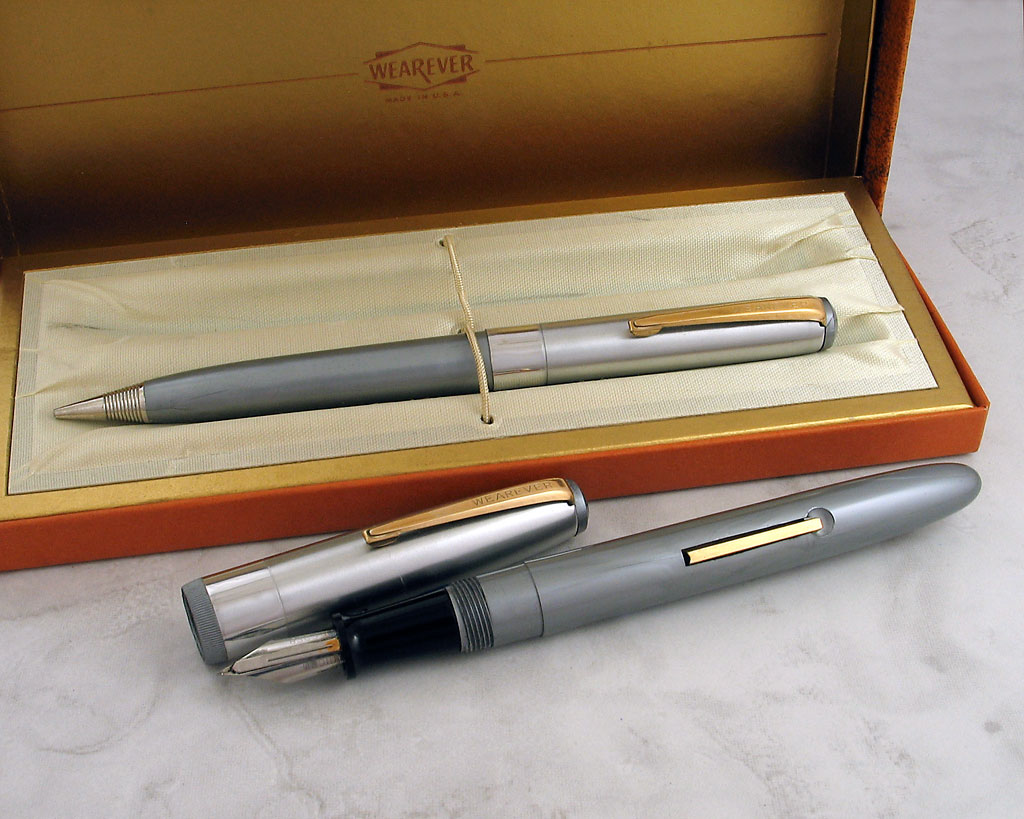 Wearever Pennant fountain pen and pencil set in original box, version 1, Gun Metal c1950-1956
David Kahn, Inc. kept the Pennant priced aggressively at $1.00 through its long production run. In the mid to late 1950s, David Kahn, Inc. introduced essentially a cartridge version of the Pennant called the Saber. Visually the two pens are nearly identical except the Saber has no side lever on the barrel and the nib does not have an overfeed.
Funky Pennant Features
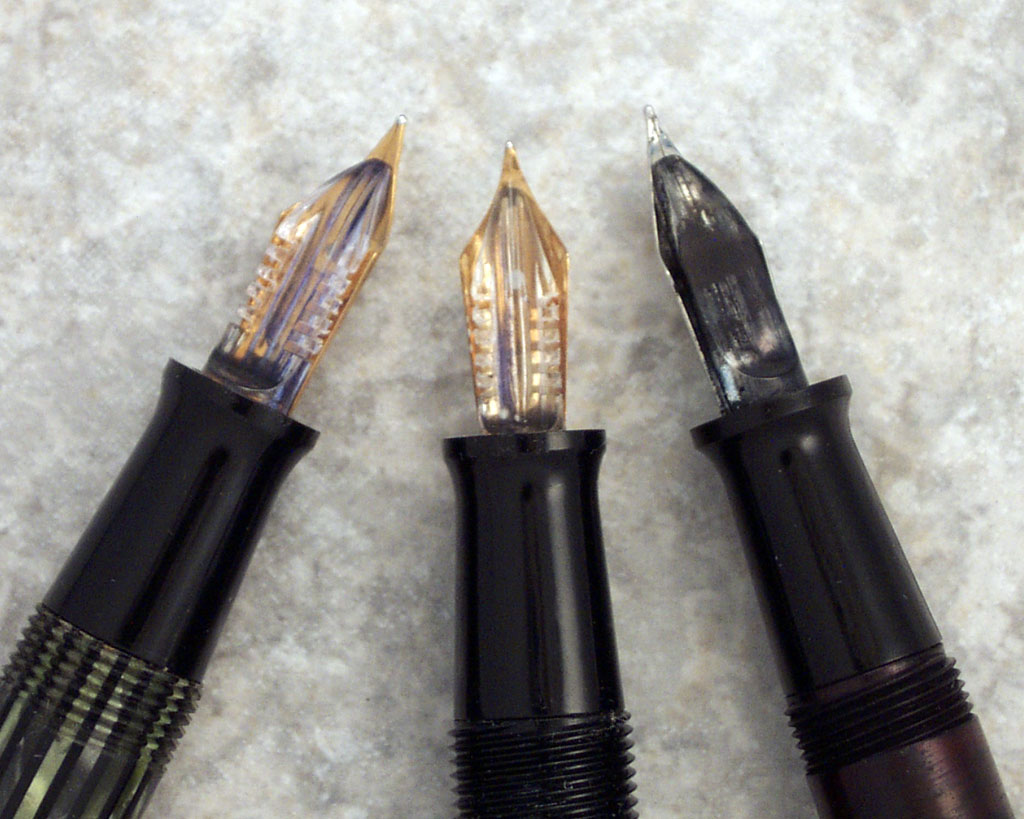 Detail of Wearever C-Flow feeds: (Left to Right) Pacemaker / Zenith / Pennant
One doesn't look for features on cheap pens, but David Kahn, Inc. put them on the Pennant. One interesting feature of Pennant is the "C-Flow" feed. This is a clear plastic feed that allowed the user to "see the flow" of ink, so it would be obvious when to refill the pen. When the feed started looking light on ink, it was time to refill the pen. This is an interesting twist on the visulated sections that started appearing on pens in the 1930s, that helped the user see how much ink was left. Visulated sections and barrels were on the way out by the end of the 1940s, so this Pennant feature was an interesting and probably cheaper to make throwback. David Kahn, Inc. first introduced the C-Flow clear plastic feeds on the earlier Pacemaker and Zenith pens in the 1940s.
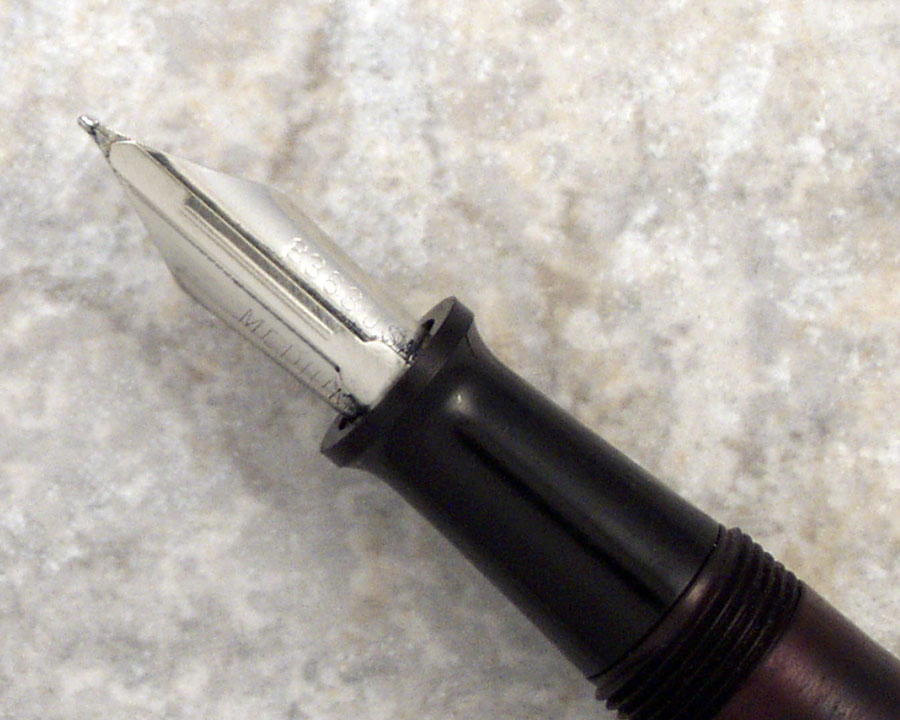 Detail of Wearever Pennant #8363 medium nib. Note the metal "Overfeed"
Another feature that has an anachronistic twist to it is the "overfeed" on the nib. The Pennant nib has a bar mounted on top from the section nearly to the tip, like an overfeed on an early eyedropper pen. On early pens, the overfeed bar was intended to keep the nib from drying out when the pen was left uncapped, but on the Pennant, it seems to make no difference. It does appear to make the nib a bit stiff, perhaps reinforcing it, but since stiff was "in" in the 1950s, this would not have been an issue to pen buyers. The overfeed can be stainless or gold toned. It appears to have been dropped with the introduction of the very similar Wearever Saber cartridge pen.
A Personal Point For Your Pennant
An interesting selling feature of the Pennant was the "Personal Point". This allowed the purchaser to buy any point they wanted for the pen at the place of purchase, or possibly later, after the sale. Don't get the idea that this system worked like the Wahl Eversharp Personal Point system or the later Esterbrook system, where the nib unit simply unscrewed from the pen.
 1956 Wearever Pennant advertisement detail: Boy, is that sales guy proud to sell Wearevers!
Replacement nibs were nothing new in the 1950s. Several other manufacturer have offered them, with Esterbrook, a contemporary competitor in the 1950s, being the most widely known and most popular. What's unique about the Pennant approach to replacement nibs is the Wearever Pennant system included not just the nib, but the entire section with the ink sac attached. As a result, the Pennant "Personal Points" came in long boxes, nearly as long as the pen itself. The change was made by unscrewing the cap, pulling out the friction fit section, sac and all, and pushing in the new "Personal Point" unit.
 Wearever Pennant version 1 Maroon dismantled to show replaceable section with rubber ink sac attached
As opposed to Esterbrook's huge inventory of nib choices, the Wearever system consisted of just five: extra fine, flexible fine, steno, medium, and broad. Everything any pen user could want! It is notable that the selection included a flexible nib throughout production, up to the early 1960s.
And it's flexible, too!
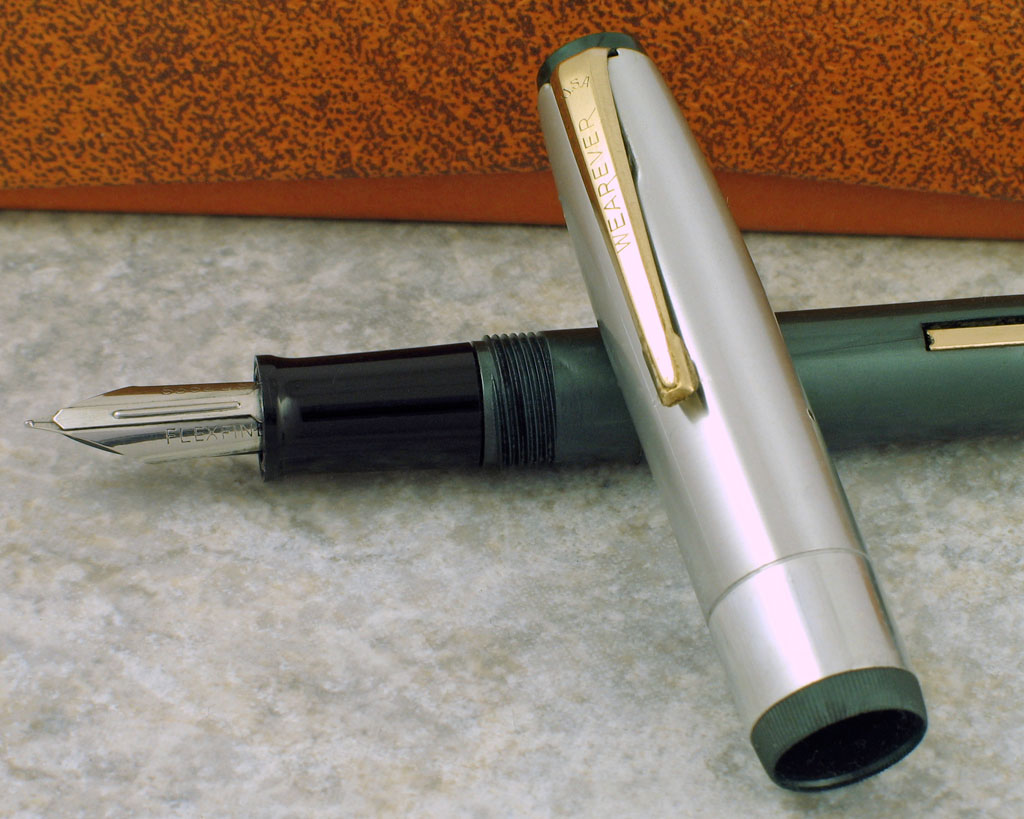 Detail of Wearever Pennant version 1 Green with Flexfine nib
Although flexible nibs were on the wane by the 1950s, some pen manufacturers still offered some flexible choices to their customers. Sheaffer offered six flexible Triumph nibs out of a total of sixteen nib choices on the 1952-1959 Snorkel pen and ten flexible or semi-flexible choices on the Tip-Dip Touchdown pens.
Where the Wearever Pennant was offered with five different point choices, only one was flexible, the flexible fine. This nib is sometimes referred to as Flexfine, due to the nib stamping. Although called flexible, the nib writes more like a semi-flex or soft touch nib.
Identification guide and features:
Lever-fill models, c1950-1960, based on advertising appearances, copyright dated ephemera and observed examples.
- Injection molded solid color plastic resin cap and barrel
- Observed and advertised named colors: black, burgundy, red, gray, green, blue, and aqua (a pale blue)
- Cap has silver color metal sleeve overlay
- Base of cap has barrel color coin edge segment and barrel color cap top
- Cap sleeve has 3/8 inch or 1/8 inch polished band section near cap lip
- Chrome or gold tone metal clip with USA at top, WEAREVER down the face and three lines near the tip
- Clips are 1 7/16 or 1 1/4 inches long, longer clips have a flat face - observed pens are consistent where longer clips are chrome and shorter clips are gold tone
- Side lever color matches clip color, chrome or gold tone
- Barrel imprint on three lines: WEAREVER "Pennant" over NORTH BERGEN, N. J. over U. S. A. - barrel imprints are often very light
- Stainless steel nib marked with nib grade on side face and nib number on opposing side face
- Five nib grades: Extra Fine, Flexible Fine (stamped FLEXFINE), Medium, Broad, and Steno
- Stainless steel nib "overfeed" with some models gold tone "overfeed"
- Clear "C-Flow" feed
- About 5 1/2 inches long capped and 6 1/4 inches posted
- Lever-fill mechanism
- Section pulls out of barrel, including ink sac, to exchange nib grade
- Retail price for the fountain pen was US $1.00, matching pencil was US $.98, PresClik ballpoint, c1953-1955, $.98, Deluxe Ball Pen, c1956-1960, $1.00
- Packaged in paperboard boxes and on hang cards
Mint / unused pens can be found with cardboard tags looped under the clip showing "PENNANT" and nib size and in some cases on obverse side "AS ADVERTIZED IN LIFE". Some mint / unused pens may have stickers on the cap indicating the nib size. Packaging includes pen and pencil sets in cardboard gift boxes and hang cards with a clear plastic holder for the pen. Pens were also sold loose on counter top cardboard stand up displays and carousel displays.
Performance
Pennants are very common pens that turn up everywhere, in antique stores, eBay, estate sales and pen shows. The Pennant is a very durable pen that is often found in working order and if not, are very easy to resac and put into use. The worst thing about the Pennant is the metal cap is very easily scratched - a common defect. These pens weren't treated as heirlooms, and this often shows on pens found in the wild.
The burgundy Pennant featured in this article is a typical Pennant, fitted with a medium nib. The Pennant is fairly large, about 5 1/2 inches long capped and 6 1/4 inches posted. It's on the light side, but considerably heavier than its sister pen the Supreme, and feels substantial enough. It's actually a fairly well balanced pen, posted or not.
Pennants are much better made for a pen three times the price of the Supreme, and for a pen that sold for only a dollar. There is more detailing, such as a faux cap band, coin edge on the cap lip, the plastic is much better quality, the plating is much better, and it is manufacturing finished more. The plastic on this pen is actually a tad iridescent. Pretty cool. The pen is imprinted on the barrel with the Wearever and Pennant names, as in the earlier Pacemaker and Zenith pens. Fit and finish are on par with those pens.
 Wearever Pennant version 1 Maroon (Top) with a Wearever Pacemaker Green Stripe (Bottom)
The Pennant has a number of design similarities with the earlier Wearever Pacemaker and Zenith lines. The cap and clip show the family resemblance, with the Pennant being a little less Parker like. The clip has a little give, so the pen will be fairly easy to pocket with most materials and it will stay put. Because of the cap top mounting of the clip, the pen will sit low in the pocket, as with the Pacemaker.
A few quick pumps of the lever and the Pennant is ready to write. I tried several Pennants, with extra-fine, Flexfine, and medium nibs. On most of the pens the nib is as stiff as one would expect from a 1950s pen, but actually quite smooth. All were good, but not great writers, laying down a respectably wet line with no variation. A good, utilitarian writer, as expected from a cheap, mass produced pen.
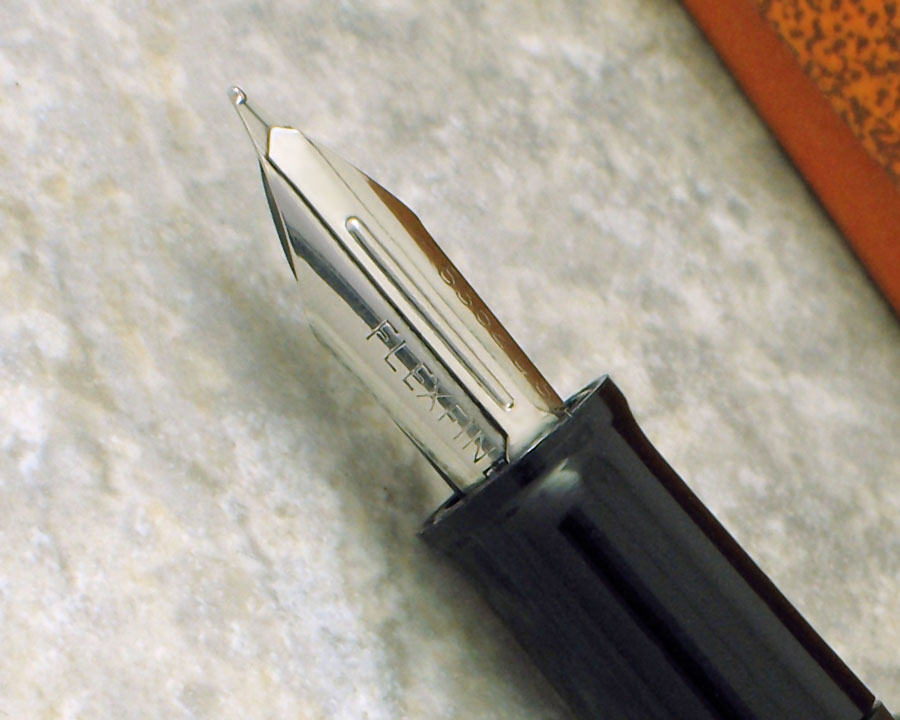 Detail of Wearever Pennant Flexfine nib
The Flexfine nib was interesting, and a bit of a disappointment. I managed to get my hands on two of these. One was on a pen loaned by Christopher Tate, and was the first one I had used. Surprisingly, the tines don't really split very much, as a flexible nib should. Perhaps this is a function of the overfeed, but I would have to do surgery to find out why. The nib seemed to have "give" more than flex. The second sample Flexfine came with a pen that was part of a "bag o' pens" I bought, and wrote exactly the same, confirming my earlier findings. I actually had a medium nibbed pen that wrote more like a true flexible than either of the Flexfine nibs.
A Pennant is not going to be an expressive writer, but a good everyday pen for the budget minded. Exactly as advertised. The nib, because of the "overfeed", is difficult to clean, so expect the nib to always be a little inky on top. I would be interested in also trying out the flexible fine nib to see how it test drives.
Pennants are ubiquitous. They turn up everywhere vintage pens are found. My guess is that there was an alien conspiracy that forced all Americans to buy at least one Pennant, and even if it wasn't used, they wound up in desk drawers or like change, in the bottom of sofas.
Should you collect Pennants? They aren't bad pens, but don't get into a panic! A few in cool 1950s colors can make a neat cheapie corner to your collection. Maybe I watched a few too many 1950s SciFi movies before finishing this article...
Don't panic! Get a Wearever Pennant!
References
Wearever Lever-Fill Pennant cardboard sales display © copyright 1960 David Kahn, Inc.
Advertisements from the following issues of Life Magazine:
- April 24, 1950
- May 29, 1950
- August 21, 1950
- September 18, 1950
- May 14, 1951
- September 1, 1952
- November 17, 1952
- May 18, 1953
- September 17, 1951
- August 23, 1954
- September 6, 1954
- May 2, 1955
- May 7, 1956
- September 3, 1956
Acknowledgement
Thanks to Christopher Tate for loaning the Pennant with the Flexfine nib.
Interact
Comments on this article may be sent to the author, Jim Mamoulides
Pen Clubs

Social Media


Pen Forums